You don’t have to be injured to benefit from physical therapy. Whether you play competitive sports, train at the gym, run recreationally, or simply want to stay active, the way your body moves can affect both performance and comfort. Physical therapy can identify limitations in strength, mobility, balance, and movement mechanics and use targeted exercises to help you perform at your best.
1. Improve Strength and Movement
Sports require much more than strong muscles. Your joints need adequate mobility, your muscles need to work together efficiently, and your body needs enough strength and control to handle the demands of your activity.
A physical therapist can evaluate movements such as squatting, running, jumping, reaching, cutting, or changing direction. If an area of weakness or limited mobility is identified, exercises can be selected specifically to address it.
For example, an athlete with poor hip or core control may benefit from strengthening and movement training designed around the demands of that athlete’s sport.
2. Improve Balance, Coordination, and Stability
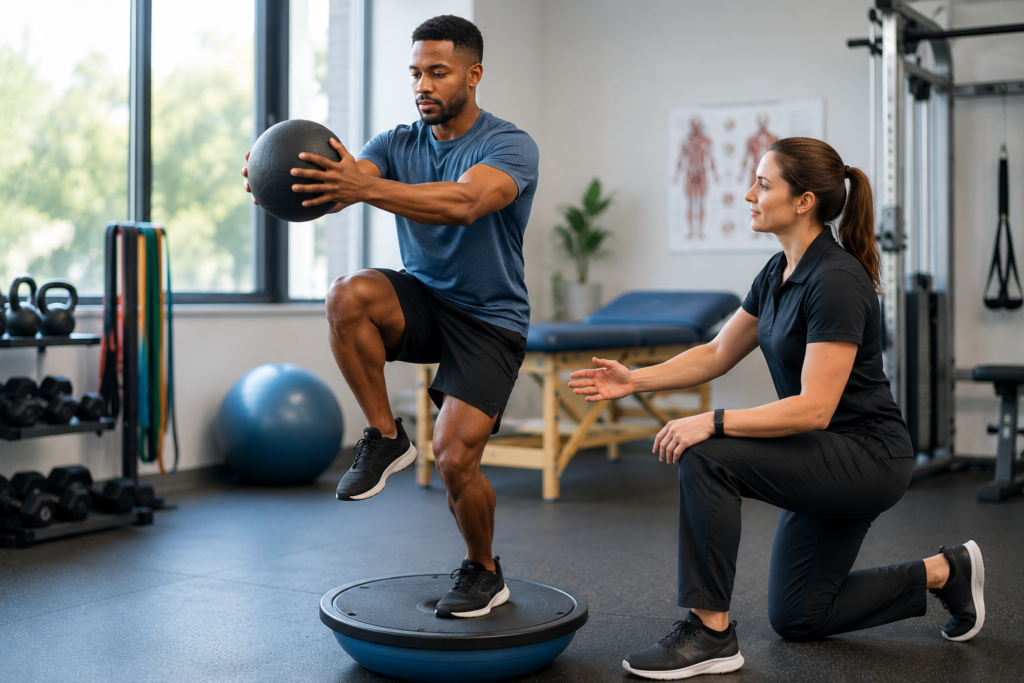
Balance and body control are important in nearly every sport. They become especially important during activities involving running, jumping, landing, rapid changes in direction, or movements performed on one leg.
Physical therapy may incorporate balance exercises, coordination drills, stability training, and progressive functional activities. These exercises can challenge the body in ways that better prepare an athlete for real-world movement.
The goal is not simply to become stronger—it is to improve how effectively the body uses that strength during activity.
3. Address Problems Before They Interfere With Your Activity
Sometimes an athlete notices a problem before experiencing a significant injury. A shoulder may feel tight during an overhead movement, a knee may become uncomfortable after running, or one side of the body may fatigue more quickly than the other.
Ignoring recurring symptoms and continuing to train through pain can allow a problem to interfere with activity.
A physical therapy evaluation can help determine whether strength deficits, mobility restrictions, movement mechanics, or another musculoskeletal issue may be contributing to the symptoms. Treatment can then be individualized based on the findings.
Physical Therapy Isn’t Only for Recovery
Many people associate physical therapy with recovering from surgery or an injury, but rehabilitation can also help active individuals improve movement and safely return to higher levels of activity.
Depending on your needs, a program may include therapeutic exercise, strengthening, mobility work, balance training, manual therapy, and sport-specific functional activities.
At Easy Reach Chiropractic & Physical Therapy, we work with patients at different activity levels—from recreational exercisers to athletes recovering from injuries—to develop individualized rehabilitation programs based on their goals.
Whether your goal is returning to your sport, improving your movement, or staying active with fewer limitations, our Lake Worth and Fort Lauderdale teams can help determine an appropriate plan.