
Sciatica can turn simple activities like sitting, walking, driving, bending, or getting out of bed into painful tasks. The discomfort may begin in the lower back or buttock and travel down the leg, sometimes accompanied by numbness, tingling, or weakness. Because sciatica can have different underlying causes, finding the right treatment starts with understanding what is irritating or compressing the affected nerve.
What Exactly Is Sciatica?
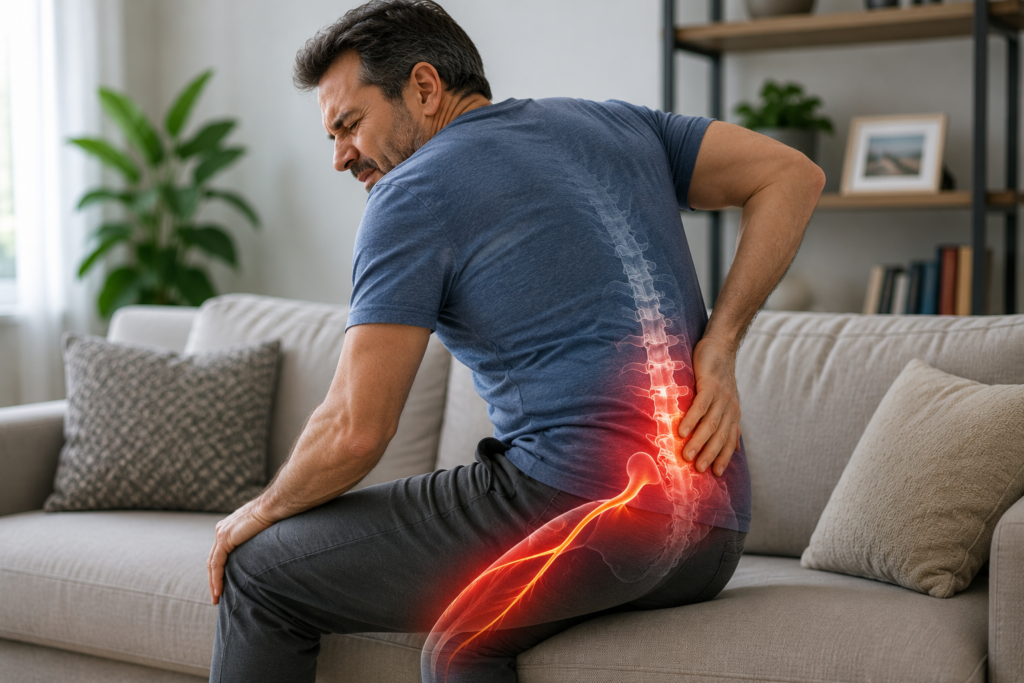
Sciatica describes symptoms involving the sciatic nerve, which travels from the lower back through the buttocks and down each leg. When a nerve root that contributes to the sciatic nerve becomes irritated or compressed, pain may radiate from the lower back into the buttock, thigh, calf, or foot.
Some people experience a sharp or burning sensation, while others describe aching, tingling, numbness, or an electric-like pain. Symptoms usually affect one side, although the exact location and intensity can vary.
What Causes Sciatica?
A herniated or bulging disc is one possible cause of sciatica, but it isn’t the only one. Changes in the spine such as spinal stenosis or degenerative changes can also place pressure on or irritate the nerves.
This is why an appropriate examination matters. Treating every patient with the same approach simply because the pain travels down the leg may overlook the actual source of the problem.
Physical Therapy for Sciatica
Physical therapy can help address problems with strength, flexibility, mobility, posture, and movement that may be contributing to symptoms. Treatment may include therapeutic exercises, stretching, strengthening, mobility work, and instruction on safer ways to perform everyday activities.
As symptoms improve, exercises can be progressed to help patients return to activities such as walking, working, exercising, lifting, and performing household tasks with greater confidence.
Chiropractic Care and Spinal Decompression
For appropriately selected patients, chiropractic care may be another conservative option for musculoskeletal problems associated with sciatica. Treatment is based on the patient’s examination findings and may be combined with physical therapy when appropriate.
Nonsurgical spinal decompression may also be considered for certain disc-related conditions. This treatment uses controlled traction to gently stretch the spine and reduce pressure on affected spinal structures. Spinal decompression is not appropriate for every patient, which is why determining the cause of the symptoms comes first.
When Sciatica Needs Immediate Attention
Most cases of sciatica do not represent a medical emergency, but certain symptoms require prompt medical attention. Seek urgent evaluation for significant or worsening leg weakness, loss of bladder or bowel control, numbness around the groin or saddle area, or other rapidly worsening neurological symptoms.
Finding the Right Treatment for Your Sciatica
There isn’t one treatment plan that works for everyone with sciatica. The best approach depends on what is causing the nerve irritation, how severe the symptoms are, and how the condition is affecting everyday function.
At Easy Reach Chiropractic & Physical Therapy, we evaluate patients experiencing lower back pain, radiating leg pain, numbness, tingling, and other musculoskeletal symptoms. Our Lake Worth and Fort Lauderdale locations offer chiropractic care, physical therapy and rehabilitation, and nonsurgical spinal decompression when appropriate to help patients improve movement and return to daily activities more comfortably.